
• Home
  • Mission
    • Our Team
    • Our Partners
    • Blog
    • Publications
    • Career Opportunities
  • Services
    • Designing Systems of Care >
      • Health Plans
      • Health Delivery System
      • Departments or Ministries of Health
      • Bundled Payment Models
      • Accountable Care Org (ACO)
    • Team Performance
    • Program Evaluation
    • Advanced Preventive Care System >
      • If this were a pill
      • Advanced Preventive Care
      • Replication Consultancy
      • SPERO®
      • Results
      • Presentations
  • Research Areas
  • Donate
  • Contact Us
Health Quality Partners (HQP)

New Partnership will Design Systems to Spread Advanced Preventive Care

8/20/2018

0 Comments

 
By Ken Coburn, MD, DrPH, FACP, CEO and Medical Director at HQP

​
​Effective models of preventive care for high-need patients do exist but require new organizational capabilities to implement.  This is one reason the use of such models has not yet become widespread.  But if effective models of preventive care were more broadly available to high-need patients, the health of millions of Americans could be improved and the cost of health care better controlled - especially for the growing population of chronically ill older adults.  A new partnership is committed to determining whether an innovative approach to designing systems for replication can help achieve this goal by making it easier for adopting organizations to learn how to implement such models.  
 
This unique opportunity is made possible through the support and leadership of the Peterson Center on Healthcare that is enabling a partnership between the Center, Health Quality Partners (HQP), and the Camden Coalition of Healthcare Providers’ National Center for Complex Health and Social Needs (Camden Coalition) to engage an innovation design firm and a group of experts with diverse backgrounds, including implementation science, quality improvement, organizational leadership, health services research and evaluation, nursing, and community-based care models.  The project will use HQP’s system of Advanced Preventive Care (APC) as a well-tested exemplar of a preventive intervention for a high-need population.  The goal will be to design more efficient implementation methodologies and infrastructures to accelerate the adoption of APC for better patient care. The Camden Coalition and HQP, in collaboration with an interdisciplinary team from the University of Pennsylvania’s NewCourtland Center for Transitions and Health within the School of Nursing, will also develop an evaluation framework to test the newly designed systems for replication and share key learnings with the field that may help to scale other efforts underway. 
 
This project represents an essential starting point and a key area of R&D for pursuing the long-term goal of achieving large-scale adoption and implementation of effective models of care for high-need patients.
0 Comments

REPLIDAPTION: integrative thinking to scale effective models of complex care

3/18/2018

0 Comments

 
By Ken Coburn, MD, DrPH, FACP, CEO and Medical Director at HQP
​
​What’s most important?  Replicating a proven care model with high fidelity in order to get reproducible results?  Or adapting (i.e., changing) a proven care model to fit and work effectively within a specific context or environment?  At first blush these two choices seem at odds, diametrically opposed to one another – increase one and you inevitably decrease the other.  The cognitively uncomfortable truth is that, in most real-world settings of health care delivery, both high-fidelity replication and local adaptation are critical to the success of spreading even a “proven” model of care delivery to other sites.  The scaling of a model that worked at original site #1 can fail by holding too fast to either concept at the expense of the other as one attempts to implement in sites #2, 3, etc. 
 
It may be better to think of combining the two concepts (replication, adaptation) within a single optimization function through which one seeks to find a balance point that maximizes the probability that a new implementation of a proven model will be effective in achieving the desired health outcomes for a given setting and population.  This may be especially relevant for models of care serving complex populations that require a broad set of dimensions to be effective; protocols, standards, and specifications, along with a compatible organizational or team culture, and principle-driven decision-making.
 
To innovate systems of replication that more effectively and efficiently spread and scale models of care, we must simultaneously innovate systems of adaptation and have the two work in synchrony.  These must occur together since, in practice, they proceed very nearly at the same time and in the same place.  Two systems?  Or one?  Some might argue that a new generation of “replication” systems could simply incorporate the concept of adaptation within them – replication now needing to address not only fidelity, but also adaptation.  Perhaps.  But this would likely lead to a linguistic and cognitive bias in which the classical meanings associated with replication are automatically assigned more importance than the newly engrafted concept of adaptation. 
 
Instead, we could conceive of a single system of replidaption that facilitates both replication and adaptation simultaneously in a manner that sees both as critical variables in an optimization function – not in opposition to one another – but interrelated, with each contributing to the success of sites adopting and implementing a new model of care.
 
If there is utility in the term replidaption, it is not in the cleverness of its word play.  A portmanteau of “replication” and “adaptation”, the power of the term is in changing the way we think and innovate – to one that is more integrated, holistic, and effective.  To be useful, this way of thinking must ultimately offer some advantage to those deciding to design systems of replidaption rather than systems of spread that continue to struggle to reconcile the duality of replication and adaptation as separate and competing processes.
 
I think replidaption could prove to be a very useful term and mental construct because it is more likely to compel model innovators to think about how to apply their knowledge to optimize adaptation at each unit of spread; not simply whether or how much adaption to allow, but specifically how to adapt in ways most likely to preserve model effectiveness.  At the same time, the construct calls upon adopters to play a more active role in providing an understanding of site context and the necessary inputs for adaptation while simultaneously stretching to achieve fidelity.  I and the team at HQP are excited to collaborate with others, to further develop the concept and methods of replidaption and to design systems of replidaption that can be put to the test.

0 Comments

Design: the Art of Possibility

11/18/2017

0 Comments

 
Picture
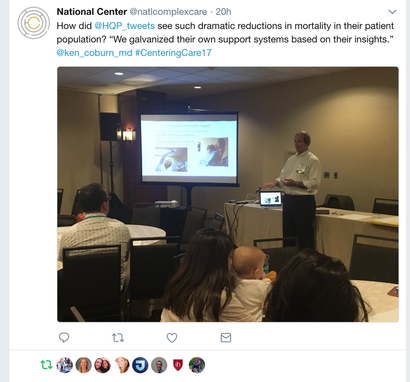
I had the privilege of sharing Health Quality Partners’ unique approach to designing systems of care in a workshop yesterday, 11/17/2017, at the Putting Care at the Center conference of the National Center for Complex Health and Social Needs in Los Angeles. The workshop was full of engaged and committed attendees seeking to create better health care systems through design. The feedback from both highly experienced designers and those new to the field was extremely positive and helpful.  I'm grateful for everyone's thoughts and insights.

The HQP approach follows in the tradition of design thinking, but adds elements of applied systems thinking and organizational culture that are crucial to achieving effective team-based models of care in the community capable of managing the complexity of vulnerable populations. The “no compromise” design approach is anchored in the need to develop longitudinal, trusting relationships with participants and prioritize effectiveness. This approach yielded HQP’s model of Advanced Preventive Care, which has been rigorously tested over 17 years and shown to reduce mortality and health care costs with a positive ROI among chronically ill older adults. The same design approach is now being used by HQP to innovate dissemination of Advanced Preventive Care to other organizations through HQP's Replication Consultancy service.

There are many more variations of systems of care to be designed and tested using the HQP approach that hold great promise for improving health and reducing cost among a diverse array of complex, higher-risk populations and environmental and organizational settings.  If we can imagine the future health care system we desire, we can design it.  If we design it, we can implement it.  If we implement it, we can change everything.

---
Note - The phrase The Art of Possibility came to me from the title of a book, "The Art of Possibility: Transforming Professional and Personal Life" by Rosamund Stone Zander and Benjamin Zander that I highly recommend.

More about Health Quality Partners (HQP) here - https://www.hqp.org/

More about the National Center for Complex Health and Social Needs here -  https://www.nationalcomplex.care/  @NatlComplexCare #CenteringCare17


0 Comments

Replicating Effective Models of Complex Care ...

6/7/2017

0 Comments

 
An article based on HQP's work, informed by my doctoral research on the challenges and possibilities of replicating effective models of complex care, was published today as a Health Affairs Blog post.  Click here to give it a read.  HQP's program of advanced preventive care is one of only a handful of complex care management programs with high-quality evidence of effectiveness.  But the disciplined and systematic approach required to implement HQP's program makes it challenging for others to adopt and replicate.  Unfortunately, there are no shortcuts, as there is no evidence that adopting 'alternative' models that are simpler, easier, and cheaper to adopt, are effective.

One possible solution is to innovate the replication process itself. Replication consultancy is an approach that HQP has developed to partner with adopting organizations to provide them with all the needed training, analytics, tools, implementation planning and support to successfully implement and sustain HQP's program of advanced preventive care.  The key is to continue to relentlessly innovate new program designs AND new methods of replication needed to spread these programs.  Large scale, sustained support, applied R&D and carefully crafted evaluation research is needed to help evolve this field in a manner that is credible, progressively more effective, and broadly useful.

We can and we are doing this.  Strong, visionary leadership and a constancy to purpose is essential.  Two organizations with such leadership that have partnered with HQP are Doylestown Health (Doylestown, PA) and Martins Point Health Care (Portland, ME).  Our colleagues at the Camden Coalition of Healthcare Providers which hosts the National Center for Complex Health and Social Needs have been terrific collaborators and co-authored the Health Affairs piece.  We hope to inspire and recruit others to support and engage in this important and promising work.  Let's go.
0 Comments

Launch of the National Center for Complex Health and Social Needs: A Personal Reflection

12/10/2016

1 Comment

 
At a crucial time in my 36-year health career I choke up, get inarticulate, can’t complete my sentences.  I’m emotional, deeply moved, feeling the momentous importance of a moment I have spent my whole career working toward.  It's Friday, 12/9 and I’m speaking (or trying to) on the panel of the closing plenary session of the inaugural conference of the new National Center for Complex Care and Social Needs (Putting Care at the Center) – the brainchild of my friend Jeff Brenner, his remarkable team at the Camden Coalition of Healthcare Providers, and virtually all the nation’s prominent health care foundations.  Here’s why I choke up.
 
The new National Center offers the possibility of remaking healthcare to improve the health and well-being of our most vulnerable, neglected, and forgotten.  To do so in a completely whole-person, whole-system way.  Motivated by love and compassion, with the deep respect, non-judgement, and desire to learn and understand, to afford everyone – “patient” and “provider” – the dignity to fail.  To fail, but never relent on the path to success.  To be courageous warriors together.  To stop at nothing.  That was the overwhelming feeling that hundreds, from diverse backgrounds and roles, gathered at this conference were sharing.  Not as an abstraction, but as evidenced by the heroes and pioneering models of care delivery achieving incredible health outcomes, that were present in the room -  irrefutable proof that this is possible.
 
I attempt to share with the audience the crucial next steps I believe the new Center must consider to move toward this audacious aim.  First, we must always remember the deepest and truest source of what motivates us – love.  Second, as Einstein observed, “We cannot solve our problems at the level of thinking we created them.”  We need a new level of thinking.  We need to examine the assumptions, biases, preconceptions, and rigid mental models that paralyze our current level of thinking.  We must probe, dissect, and take them apart … in preparation of creating something new.
 
It is critical that we fully understand how much this will require of us – and that we don’t try to shortcut or ignore that reality.  Open-hearted listening to those with whom we partner and serve, must be translated into new models.  Robust models.  Faithfully executed models.  Measurable models.  We need master designer/model builders – and many of the best were at the conference.
 
Once we design the models we must implement them with fidelity.  Because these models are new, complex, and multifaceted, they are not easy to implement reliably.  But they must be implemented reliably or they won’t work. We need new management systems, driven by data captured from the field and patients, analytics providing new measures of service reliability and team performance, and a team-based learning culture.  We need master implementers and there were many at the conference.
 
Once designed, implemented, and honed these new models must then be scaled and rigorously evaluated.  Not every program need be formally evaluated in robust longitudinal studies like randomized trials, but larger implementations should be.  These two steps; scaling and rigorously evaluating are vital and interdependent.  Without sufficient numbers of people served across different settings, it’s impossible to credibly evaluate new models.  To avoid the sins of the unfettered medical-industrial complex - selling us vast amounts of costly health services, but not more health - we must demonstrate the benefit our models bring to society.  Our approach of person-centered, prevention-oriented, highly disciplined, whole-system redesign promises to yield far better health at lower cost than our current approach – but we must prove it.
 
For models that are well-designed, well-implemented and proven effective in rigorous studies we must find better ways to disseminate their use.  The use of knowledge purveyors and change agents alone is not sufficient to spread these more complex, whole-system designs.  The field of dissemination is now ripe for new thinking, applied R&D, and innovation.
 
But none of these ideas are coming out of my mouth clearly or completely. The fact that only a handful of intensely dedicated programs have successfully fought their way through all phases of this long and arduous life cycle of maturation is testimony to how challenging the work ahead is for the National Center.  But all the pieces are here.  The will is here.  We can do this.  We just need a plan.  A design.
 
I’m trying to convey how we must embrace, organize, and integrate the broad range of talents and expertise needed to undertake all elements of this work – listening, designing, implementing, scaling, evaluating, disseminating, policy advocacy, and funding – with an appreciation of the long timelines needed to fail before succeeding, taking a whole-person, whole-systems approach, and always working in direct partnership with those we serve.  But instead, I feel I am muttering – overwhelmed by the memory of the testimonies of consumers - suddenly realizing that many of those we serve love us too.  Not in a sentimental way, but in the most deeply human way – by giving us their trust – turning to us for hope - courageously baring their most intimate violations, pains, and sufferings in hope that we will respond with kindness, compassion, respect, understanding, and help.
 
Afterwards Jeff and colleagues are gracious and kind with their feedback.  Themselves knowing full well that this work is a marathon, not a sprint.  That missteps are the norm, not the exception.  That the perfect articulation of the work is nearly impossible. And that ultimately the aim will be achieved by being constant to our purpose and working together.  Thoughtfully, skillfully, compassionately.  Let’s roll.


Note:  MANY of the ideas as well as some terms and phrases included in this post were expressed by several speakers and participants at the Putting Care at the Center conference.  Their use here is a reflection of what I gratefully took away from that experience.  I apologize for any failure on my part to specifically cite any individual contributor where that might have been more appropriate.

1 Comment
<<Previous
Forward>>
Copyright (©) Health Quality Partners (HQP) 2025.  All rights reserved.